
By David Kenneth Waldman | Author of Weep for Love
People love to talk about passion as if it were the whole symphony. In songs, in movies, and in the breathless early days of falling in love, we are taught to look for fireworks, the sudden rush of chemistry, the racing pulse, the dizzying certainty that we have stumbled into something extraordinary. Fireworks are magnificent to watch, of course. They light up the dark for a few unforgettable seconds. Yet anyone who has actually lived inside a real relationship knows a quieter truth: you cannot warm a house with fireworks, and you cannot build a life on sparks alone.
If passion is the overture that brings two people into the concert hall, trust is the acoustics of the room itself. Without it, every note distorts. Every melody turns defensive. Even the sweetest intention lands like noise.
When I wrote Weep for Love, I kept returning to this exact tension- not the easy, storybook version of romance where two people glance across a room and everything falls neatly into place, but the real, human reckoning of what happens when two people have to decide whether it is safe to put down their armor. Because love, at its core, is never merely an emotion. Love is an act of radical exposure. To truly love another person is to hand them a map of your unguarded places- your fears, your history, your failures, the quiet griefs you rarely speak aloud- and to believe, without a signed contract or a guarantee, that they will handle those fragile things with care.
That belief is trust. And in a world that constantly trains us to hedge our bets, keep one foot near the exit, and protect ourselves from disappointment, choosing to trust someone else is one of the bravest things a human being can ever do.
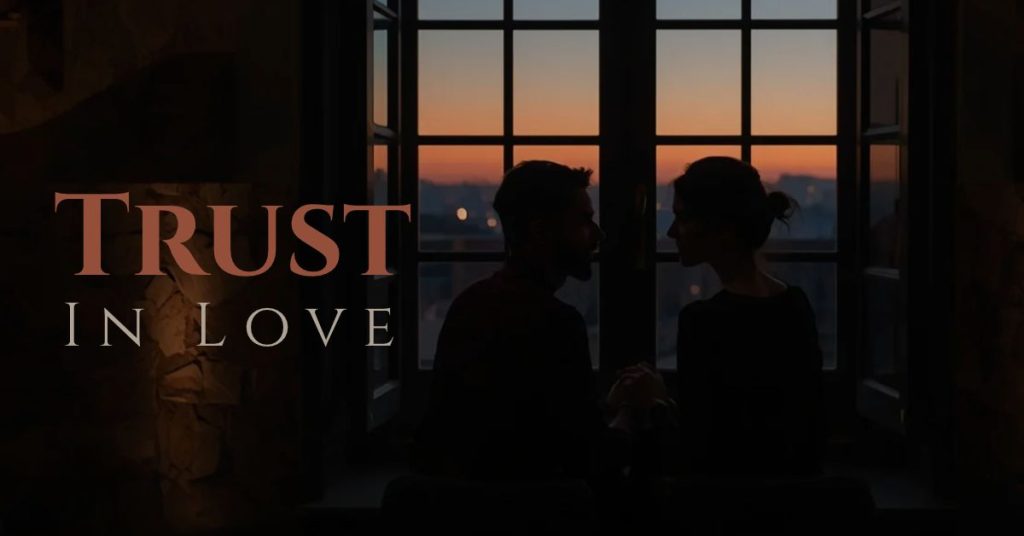
The Armor We Carry Into the Room
Most of us do not arrive at love empty-handed. We arrive carrying invisible luggage packed by every experience that came before. We carry the memory of promises that were spoken lightly and broken easily. We carry the sting of moments when we opened a door, and someone walked away, or worse, used what they saw inside against us. Over time, self-protection becomes second nature. We learn how to stay charming while keeping the inner rooms locked. We learn how to offer ninety percent of ourselves while holding back the ten percent where we actually live.
On the surface, that kind of guardedness looks like wisdom. It feels safe. If you never hand anyone the key to your deepest self, nobody can ever lock you out.
The tragedy, however, is that the very walls we build to keep pain out also keep intimacy from ever getting in. You cannot selectively numb your capacity for hurt without simultaneously numbing your capacity for joy. When trust is missing- or when it has been fractured and left untended- a relationship turns into an exhausting exercise in surveillance. You begin listening not to understand, but to detect hidden meanings. You measure every silence. You brace for the flinch before it even happens. Two people can share the same roof, the same table, and the same bed, yet remain separated by an ocean of unspoken caution.
True intimacy requires the opposite movement. It asks us to lay down our weapons in the presence of someone who has the power to wound us, trusting that they will choose tenderness instead.
Trust Is Built in Inches, Not Grand Gestures
There is a common misunderstanding about how trust is formed. We tend to imagine it as something dramatic—a crisis weathered together, a heroic sacrifice, a cinematic declaration made in the rain. Those moments matter, certainly, when life tests our foundations. Yet in the daily reality of a partnership, trust is rarely forged in grand gestures. It is built in inches, through hundreds of unremarkable moments that nobody else ever sees.
Trust is built when someone says they will call at seven, and the phone rings at seven. It is built when you confess an irrational fear, something small, perhaps even embarrassing- and the person across from you does not laugh, dismiss it, or turn it into ammunition during an argument three months later. It is built in the tone of voice used when both people are tired at the end of a long day, and in the willingness to say, “I was wrong, and I am sorry,” without attaching a justification to the end of the sentence.
Forgive the cliché, because we have all heard it a thousand times: actions speak louder than words. Yet the reason that phrase refuses to die is that human beings are extraordinarily sensitive instruments when it comes to alignment. We can feel, almost instinctively, when a person’s words and their character are playing in the same key, and we can feel just as quickly when they are out of tune. Trust is simply the cumulative memory of that alignment. Every kept promise, every moment of patience, every instance where someone chooses honesty over convenience deposits another stone into the foundation. Over months and years, those small stones become bedrock.
The Courage of Transparency
When people hear the word trust, they often think first about fidelity, about keeping promises when nobody is watching. That is an essential pillar, without question. Yet emotional trust runs even deeper than loyalty. Emotional trust is the certainty that you do not have to edit yourself to remain loved.
Think about how rare that actually is. In almost every other arena of life, we are performing. At work, we project competence. In public, we project composure. Even among friends, we often curate the version of our lives that sounds most coherent and least burdensome. A relationship anchored in genuine trust becomes the one sanctuary on earth where the performance can stop.
In that sanctuary, you are allowed to be unfinished. You are allowed to have days when your strength runs thin, when your certainty wavers, or when old wounds ache without a tidy explanation. Trust means knowing that your partner will not mistake a bad day for a broken bond, nor treat your vulnerability as a flaw to be fixed. It is the difference between being tolerated at your best and being held at your most human.
And transparency works in both directions. It is not enough to hope our partner will read our minds and anticipate our needs; we have to be brave enough to speak plainly about what is happening inside us. Silence, even well-intentioned silence, is often where distance takes root. When we withhold our truth to “keep the peace,” we are quietly trading real closeness for a fragile imitation of calm. Real peace in a relationship is never the absence of hard conversations; it is the presence of enough trust to have those conversations without fearing that the relationship will shatter.
When Trust Fractures, and What Repair Actually Takes
No two human beings walk together for very long without stepping on each other’s feet. Even in the deepest, most devoted relationships, misunderstandings happen. Words land clumsily. Stress narrows our patience. Sometimes, in moments of fear or selfishness, we let down the very person we would give our lives to protect.
What separates enduring love from fleeting attachment is not perfection; it is the capacity for repair.
When trust is bruised or broken, it cannot be restored by demanding that the other person simply move on, nor by pretending the fracture never occurred. You cannot paint over a cracked wall and call it structural integrity. Repair requires humility. It requires sitting in the discomfort of the damage without rushing to defend your intentions, listening until the other person feels genuinely heard, and accepting that rebuilding takes as long as it takes.
In Weep for Love, the deepest grief is never merely the pain of loss; it is the ache of realizing what happens when pride, fear, or unspoken doubt stands between two hearts that were meant to shelter one another. Sometimes we weep for love because circumstances tear two people apart; other times, we weep because we realize how precious that bond was only after we failed to guard it. Yet when two people dare to face the truth together, to own their missteps, strip away their pride, and choose each other again with open eyes, the trust that grows back over the healed place can become even stronger, and far wiser, than the innocent trust they began with.
The Freedom on the Other Side of Trust
Ultimately, the true value of trust is not just that it prevents betrayal or steadies a relationship through storms. Its greatest gift is freedom.
When you do not have to spend your energy guarding your back, second-guessing motives, or wondering whether the ground beneath your feet will hold, all of that energy returns to life itself. You become more generous, more playful, more creative, and more present. You stop living in defense and start living in creation. Two people who trust each other deeply do not lose their individuality; rather, they give each other a safe harbor from which to sail farther and grow fuller than either could have managed alone.
That is why love without trust always feels heavy, no matter how intense the attraction, while love anchored in trust feels remarkably light, even when life itself is hard.
At the end of our lives, we rarely measure our days by how smoothly everything went or how carefully we protected ourselves from risk. We measure them by the moments we were truly known, truly seen, and brave enough to love without holding back. Trust is what makes that possible. It is the quiet architecture beneath every lasting love story, and the reason that, even when love asks everything of us, we still choose to open the door.
Sometimes, a relationship ends even though the feelings are still

When two people fall in love, they don’t suddenly stop

Most romance readers get to know the hero through someone